Many horse owners struggle to keep their horses afflicted with Polysaccharide Storage Myopathy (PSSM) healthy. PSSM is a disease that results in an abnormal buildup of sugar in its long-chain form (glycogen) in muscles [1] [2] [3]. PSSM causes cells to store glycogen, all though it is an important fuel source for contracting muscles, the cells are stored in a form that cannot be used to create energy. This unusable form of sugar builds up in cells, while contracting muscle cells must resort to using other, less desirable fuel sources like muscle. This buildup of unusable sugar and breakdown of muscle protein causes horses to experience muscle pain, stiffness, and soreness. In some cases, horses exhibit gait asymmetry, excessive sweating, reluctance to move, and signs similar to colic [2]. There are two types of PSSM; both types cause abnormal storage of glycogen in skeletal muscle cells. However, PSSM1 is caused by a mutation to a gene responsible for the enzyme that converts glucose to glycogen for storage in muscles cells, while PSSM2 is not caused by a genetic mutation. Diet and exercise are contributing factors in presentation of both types of PSSM. While PSSM cannot be cured, it can be managed with a fine-tuned, low-carbohydrate/high-fat diet and daily exercise. Administering cannabidiol (CBD) to horses with PSSM may be helpful in mitigating some symptoms and managing the disease.
Horses consume sugars and starches for energy, and their bodies convert those sugars and starches into a fuel that cells can use. Glucose is the form of sugar that cells can immediately use for energy. If the cells signal that they no longer need more energy because the muscles are at rest, the glucose is converted into glycogen by an enzyme called glycogen synthase 1 (GSY1). Glycogen is a long chain of glucose molecules strung together in a chain. This storage form of sugar is the most organized and compact way to store glucose until it is needed again. When muscles need energy to contract, the cells signal another set of enzymes to break off one glucose molecule at a time from the chain of glycogen.
The preferred fuel for muscle cells is glucose, which is a simple sugar in its monomeric form. When contracting muscle cells deplete their supply of glucose, their next fuel source is glycogen. However, if there is no usable glycogen, the muscles must resort to another fuel source. In PSSM, muscles resort to breaking down their own proteins for fuel in a process called rhabdomyolysis. This is often referred to as “tying-up.” Tying-up is a broad term that refers to the condition when rhabdomyolysis occurs, and horses experience muscle pain, spasms, reluctance to move, and other symptoms mentioned above [3]. It is a feature of PSSM but is not unique to the disease. Tying-up may also occur in recurrent exertional rhabdomyolysis (RER), in non-exercise associated myopathies, and in response to trauma [3].
There are two types of PSSM. PSSM1 is caused by an autosomal dominant mutation in the gene that codes for the GSY1 enzyme [1] [2] [3]. This means that a horse that has just one copy of this gene from either mother or father will inherit this condition. PSSM2 is a syndrome involving abnormal storage of glycogen without any mutation to the GSY1 gene [1] [2] [3]. The disease most commonly appears in Quarter Horses and related breeds, but it has been documented in many other breeds as well [1] [2] [4].
Simple genetic testing can be used to diagnose PSSM1; definitive diagnosis of PSSM2 requires a muscle biopsy [1] [2] [3]. Symptoms of PSSM may not present right away; it is more likely that a horse will begin to show clinical signs of the disease if and when they are subjected to more extreme exertion such as in performance or racing.
Currently, there is no cure for PSSM nor is there an easy, catch-all treatment. The most reliable way to treat this disease is through dietary management and regular exercise. Specifically, horses with PSSM should have restricted non-structural carbohydrate (NSC) intake, which keeps glycogen from building up in muscles and keeps blood insulin levels low [1] [2] [3]. Fine-tuning a low-NSC/high-fat diet can be extremely tricky because caretakers must ensure the horse receives all necessary vitamins and nutrients but also maintains an appropriate weight. When tying-up or similar symptoms occur, owners and veterinarians sometimes mitigate the symptoms by using pain relievers, muscle relaxants, and non-steroidal anti-inflammatory drugs (NSAIDs) [1].
Using CBD to Treat PSSM
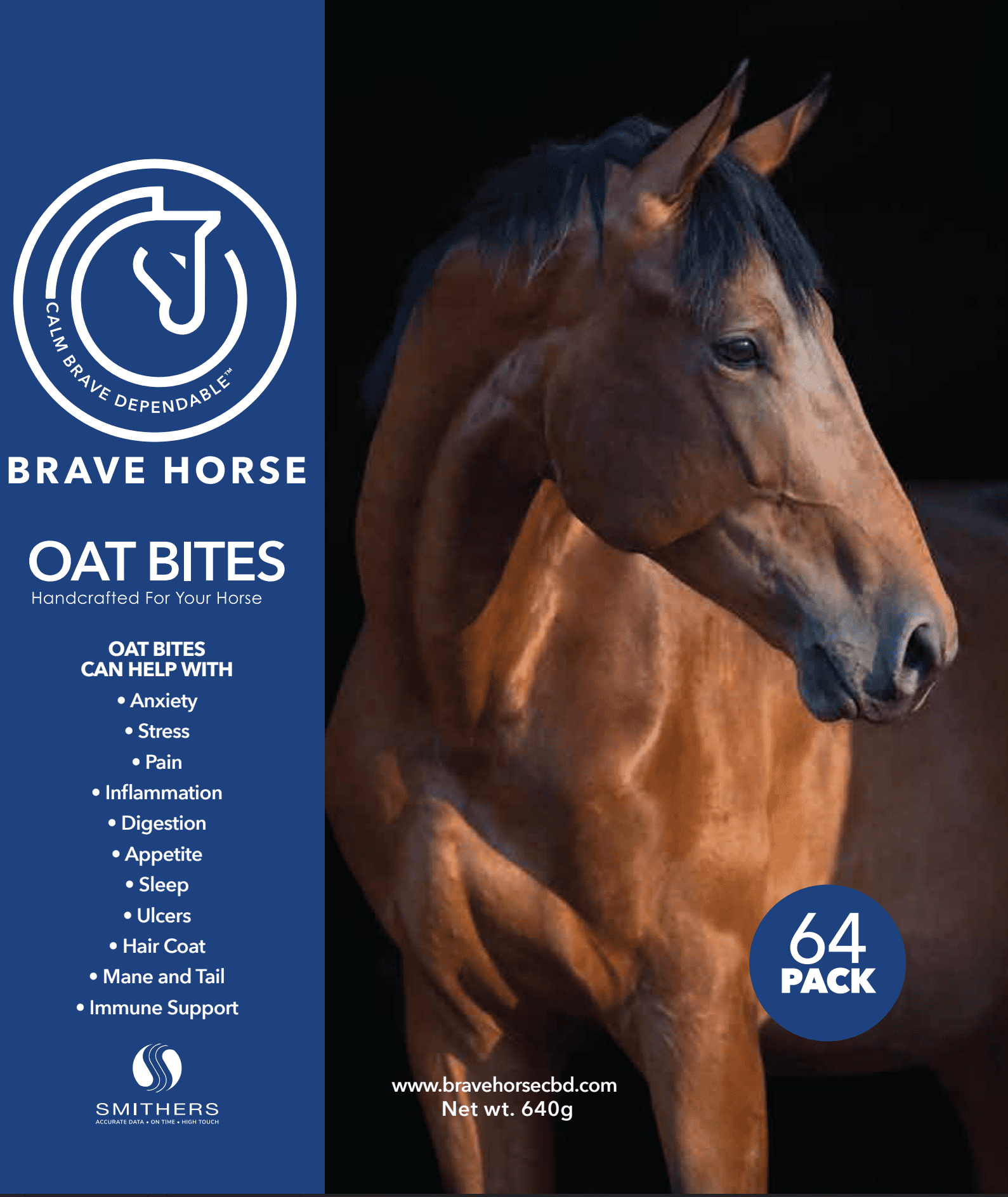
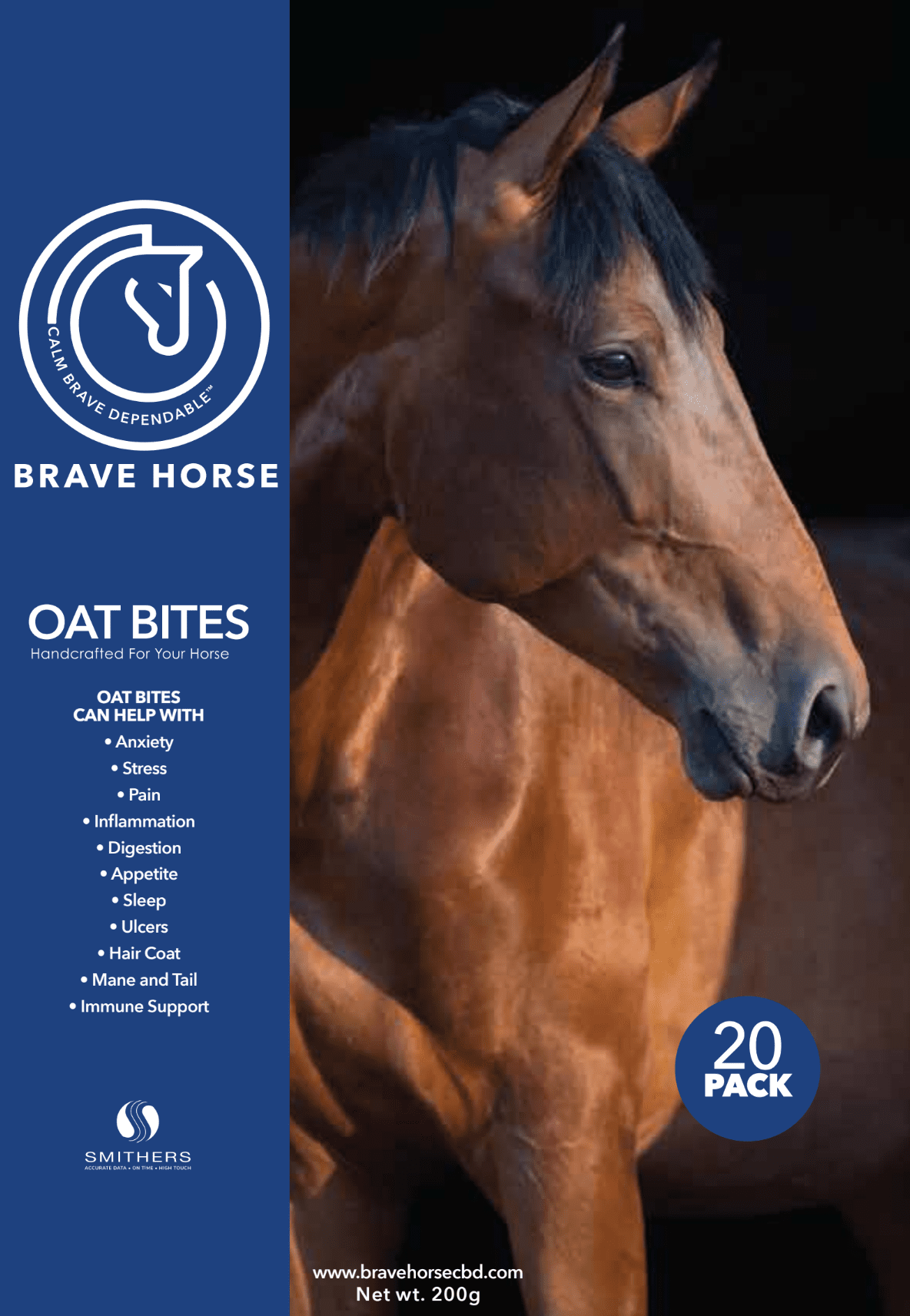
Brave Horse OatBites packed with 100mg of CBD are an excellent option for administering CBD to a horse with PSSM. Brave Horse OatBites are made without any added sugar, and each treat contains just one carbohydrate. This allows horses with PSSM to reap the calming and anti-inflammatory effects of CBD without consuming excessive sugar or starch that could aggravate their conditions. Additionally, Brave Horse OatBites are formulated with vitamin E, which has been shown to provide benefits to horses with PSSM by reinforcing the membranous structure of muscle cells [3].
While research about the effects of CBD specifically on horses with PSSM is limited/sparse, CBD has shown promise in treating some of the symptoms commonly seen with PSSM. CBD has demonstrated its utility as a non-steroidal analgesic, which is great for pain management if a horse experiences painful muscle spasms; it has also shown antioxidant, anti-inflammatory, and neuroprotective properties [5] [6] [7]. Additionally, CBD’s ability to elicit a calming effect can be greatly beneficial, especially for horses who suffer from PSSM. Many horses struggle with anxiety when they are placed in stressful situations such as trailering, seeing the farrier, or preparing for shows. This anxiety can cause horses to tense up, which is particularly problematic for horses with PSSM. Tying-up can often be triggered by stressful events [3]. Administering CBD to horses prior to any stress-inducing events can help them stay relaxed, and it can potentially prevent tying-up from occurring.
A PSSM Success Story Brought to You by Brave Horse
When Whisper came to Madi and Samantha, she was a young mare who was underweight and kicked and bucked any time she was loaded into the trailer or brought to the arena. Madi and Samantha noticed the muscle spasms and tying-up and knew those signs meant that Whisper may have PSSM. Sure enough, Whisper’s diagnosis of PSSM2 was confirmed, and Madi and Samantha made the necessary adjustments to Whisper’s diet. They noticed healthy weight gain and some great improvement, but Whisper was still tying-up every time she was in a stressful environment. They decided to administer Brave Horse CBD oil to her daily, and they began giving her Brave Horse OatBites before they put her in a trailer or ran her. They described the Brave Horse OatBites as a complete “game changer.” Their beloved Whisper is noticeably calm and relaxed, even when put into situations that used to cause stress and tying-up. The episodes of tying-up have decreased considerably, as have visits to the veterinarian. After taking it slow for two years, Whisper is a 1D barrel racer and winning in the arena. Madi and Samantha still have to be very careful with Whisper’s diet and supplement regiment but all the attention to detail have paid off! Loading for a long haul is easier and at the end of the trip a healthy horse ready to compete emerges off the trailer. With the addition of the Brave Horse OatBites to her fine-tuned diet, Whisper has transformed into Calm, Brave, and Dependable horse.
A special thank you to Samantha Martinez and Madi Campbell for sharing Whisper’s story!
References
- [1] Young, A. Polysaccharide Storage Myopathy (PSSM). School of Veterinary Medicine. https://ceh.vetmed.ucdavis.edu/health-topics/polysaccharide-storage-myopathy-pssm
- [2] Exertional Myopathies in Horses – Musculoskeletal System. Merck Veterinary Manual. https://www.merckvetmanual.com/musculoskeletal-system/myopathies-in-horses/exertional-myopathies-in-horses?query=pssm
- [3] Tying-Up in Horses | Equine Science Center. https://esc.rutgers.edu/fact_sheet/5531/#:~:text=Tying%2Dup%20is%20a%20condition
- [4] DBS Interactive. Diet Adjustments Provide Relief for PSSM Horses – Kentucky Equine Research. Kentucky Equine Research. https://ker.com/equinews/diet-adjustments-provide-relief-pssm-horses/
- [5] Thomas, A.; Baillie, G. L.; Phillips, A. M.; Razdan, R. K.; Ross, R. A.; Pertwee, R. G. Cannabidiol Displays Unexpectedly High Potency as an Antagonist of CB1 and CB2 Receptor Agonists in Vitro. British Journal of Pharmacology 2009, 150 (5), 613–623.
- [6] Karuppagounder, V.; Chung, J.; Abdeen, A.; Thompson, A.; Bouboukas, A.; Pinamont, W. J.; Yoshioka, N.K.; Sepulveda, D. E.; Raup-Konsavage, W. M.; Graziane, N. M.; Vrana, K. E.; Elbarbary, R. A.; Kamal, F. Distinctive Therapeutic Effects of Non-Euphorigenic Cannabis Extracts in Osteoarthritis. Cannabis and Cannabinoid Research 2022.
- [7] Liou, G. I.; Tang, Y.; Hanson, E.; Matragoon, S.; Liu, E. K.; Mian, S.; Zhu, G.; Khalifa, Y.; Caldwell, R. B.; El- Remessy, A. B. Neuroprotective Effect of Cannabidiol in Endotoxin-Induced Retinal Inflammation. Investigative Ophthalmology & Visual Science 2007, 48 (13), 4954–4954.